For those who are just discovering me….welcome! My husband and I currently live in Limoux, southern France, but we are in the process of making a move to Spain. In fact, we are buying a house in Andalusia.
It all began in mid-May when my sister spotted a listing of a house near the stunning white village of Cómpeta. The plan is to buy the property together, and since she had more flexibility timewise, she flew to Málaga to check it out.
From four months visiting and researching the Costa Blanca, we were already well aware that buying in Spain is rarely straightforward. And surprise, surprise, we’ve had more than a few issues. So many, in fact, that we still haven’t signed the main purchase contract or paid the standard 10% deposit.
We did sign a reservation contract, which required a small deposit to take the house off the market. Thankfully, we hired a lawyer from the start, which turned out to be one of our better decisions. We have since uncovered things we didn’t even know we should be looking for.
What’s a DAFO, and Why Does It Matter?
Looking back, it seems even the current owner wasn’t aware of some of the issues. He bought the property in May 2025 through a forced bank sale, which often means a good deal, but sometimes comes with surprises.
In the autumn, he began a few formalities with the local council, including starting a DAFO process or so we were told. For anyone unfamiliar, a DAFO is a certificate confirming a rural property’s legal status, protecting it from fines or even demolition.
As it turns out, there was no DAFO process underway. Our lawyer did some digging and found that the process hadn’t even been initiated. It was the local technical architect who took the initiative, inspected the property, and came up with a list of requirements to obtain the DAFO.
It’s a fairly long list but luckily, we already knew (and accepted) over half of the needed improvements.
Buying a House in Andalusia Comes with Surprises
What we didn’t know? That we wouldn’t be able to get a water supply until the DAFO is approved. Bit of a red flag, especially since we will need water to do renovations. A proper Catch-22.
On top of that, the current septic tank doesn’t meet modern standards, and despite there being power sockets throughout the house, we apparently don’t have an electricity supply either. Yep, it is starting to sound like an off-grid project.
Still undeterred, we asked our lawyer to relay all this to the seller and get his perspective. After much back-and-forth, we’ve come to an agreement, albeit an unconventional one.
Aerial shot of the house we are chasing
An Unusual Agreement, and a Glimmer of Hope
The seller has agreed to:
Install a new septic tank and cover half the cost.
Get electricity connected.
Somehow, don’t ask us how, arrange a temporary water supply from the neighbour. (Are they old mates? Did he bribe them with olive oil? Who knows!)
On top of that, he’s willing to leave a significant sum, probably close to 20% of the purchase price, in an escrow account with our lawyer. If we don’t manage to secure the DAFO within a year, we will get that money back. Fair enough, considering we might be facing some extra costs.
Confused? Complicated? We are too! You might even be wondering why we’re going through with it at all…
Honestly, I’m just incredibly relieved we hired a lawyer—because there’s more to this story. But that’s for another time.
After 16 weeks of exploring the Costa Blanca, our Spanish house hunt came to an end mid May – or did it not?
In my last blog post, I mentioned that we missed out on a house in Orxeta. Well, things took an unexpected turn: the buyer pulled out, and we suddenly had a chance to view the house after all.
A Second Chance in Orxeta
It was nearly perfect—great location, stunning views, and close to the charming village of Orxeta. We had a viewing and liked the house in many ways. To recap: we’re on a house hunt for a property that allows for two separate living spaces—one for my sister and her partner, and one for us.
This house technically offered that setup. In fact, the second “house” used to be a bar—and it still looked very much like one. It would take significant renovation to turn it into a home. The pool was also in poor condition, and to top it off, there was an issue with the septic tank.
In the end, we decided it would require too much cash and effort to make it in what we wanted. So, despite the near-perfect location, we passed.
Changing our focus may be on the radar!
A Change of Direction
That decision left us feeling a little deflated. Was the Costa Blanca really the right area for us? It’s hard to explain—it was more of a gut feeling than anything concrete.
A few hints led us to start looking at Andalusia—initially just online, since it’s a six-hour drive away. Then my sister came across a very interesting property and sent it our way.
At that point, we were at the end of our four-month Spain journey. Energy and enthusiasm were running low. But something about this house told us it was worth looking into. My husband even considered driving the 600 km to see it. In the end, though, my work commitments and our upcoming return to France made that difficult.
So my sister took the reins and flew to Málaga to view the property.
Changing our focus to Andalusia – impressive statue in Moraira.
Could This Be The End of our House Hunt?
They saw the property—and it immediately felt like it could be the one. It just wasn’t in Costa Blanca; it was in Andalusia. The house and land ticked nearly all the boxes—except one. It didn’t yet have a DAFO.
A DAFO is a certificate issued by the town hall confirming that a rural property is legal and won’t be subject to fines or demolition. It offers maximum security to the buyer. You can read more about it here.
Apparently, the DAFO was in the process of being issued. The catch was that no one could say when it would be finalised—meaning there was no way to guarantee when (or if) it would end up in our hands.
Now, none of us is familiar with the ins and outs of Spanish property law, rural zoning, or habitation certificates—and we didn’t want to fall into a trap. So we opted to hire a lawyer to take over and dig into the details.
Our House Hunt is Getting Serious
Five days later, we signed a reservation contract and paid a small deposit to take the house off the market. Our lawyer added a few protective clauses—if the DAFO didn’t come through, we’d have the right to withdraw or renegotiate.
That may sound easy—but believe me, it wasn’t.
My sister and her partner were on a roller coaster ride trying to get everything clarified and agreed upon. During that time, they stayed in nearby Cómpeta, in an Airbnb run by two guys who had appeared on A Place in the Sun. Cómpeta is one of those gorgeous white Andalusian villages. They met several locals, many of whom offered invaluable tips and insights about the area.
Lessons from the Road
That experience helped us make an informed decision when the ‘right’ house came along—even if it was in a different region than we originally imagined.
Villa Joiosa at the Costa Blanca is famous for its vibrant coloured housesSunrise view from Altea, a gorgeous white village on the Costa Blanca
So, to recap: we spent four months exploring the Costa Blanca, drove 6,000 km, visited dozens of towns and villages, and viewed several properties—without a concrete result. But we learned a lot along the way: what doesn’t work for us, how Spanish bureaucracy ticks, and what legal and logistical pitfalls to avoid.
That experience gave us the clarity and confidence to make an offer on this Andalusian home. With the help of a good lawyer, we knew exactly what we were getting into—and what needed to be double-checked.
The property ticks most of our boxes, and what’s missing can be addressed over time.
Thinking of living in Spain? After 13 weeks exploring the Costa Blanca and the hinterland of Alicante, we learned that finding “the perfect place” is harder than it looks
In January this year, we set off to Spain, searching for the perfect place to live. After just over 3 months, we can now conclude: this road will not be an easy one.
We chose the Costa Blanca, as we had visited before and liked the vibe. Sure, it has Benidorm — but what in life is ever perfect? The Marina Alta, with its charm, beautiful scenery, and cute towns, drew us in. We are not alone; the area is full of North Europeans who, like us, sought a different lifestyle — warmer, cheaper, or simply something new.
However, it seems we might have missed the boat, both financially and culturally. Spain has almost disappeared from this area, taken over by the Dutch and the Brits.
So, we decided to head further south and explore the hinterland around Villajoyosa and Alicante. We already checked out Castalla, Ibi, and Tibi — but for many reasons, it wasn’t our thing. One reason being the altitude of 700 meters: higher means colder, especially in winter — and escaping the cold was the whole idea!
Exploring the Alicante Hinterland: Aspe, Novelda, Monóvar, and More
This time, we picked an area right in Alicante’s backyard: Aspe, Novelda, Monóver, Monforte, and Agost. Quite an ambitious list for one day, but we managed to visit them all — and were left feeling exhausted and a bit disillusioned.
Our first stop was Aspe, with around 20,000 inhabitants. Parking was easy, and the centre pleasantly surprised us. It ticked many of our “must-have” boxes: a market, lively cafés on every corner, a gorgeous square with a lovely church, lush trees, a few cafés, and a pretty park with a fountain. I could easily imagine bubbly summer nights here. We had an excellent coffee — just €1.30 — and noticed we were likely the only English speakers around. Full of hope, we moved on!
Imagine balmy summer nights…..
Only 4 or 5 km down the road was Novelda. Again, parking was easy, but the first impression was very different. Street after street of parked cars, a random shop here and there, but not much else. No cute cafés, no hidden nooks, no real centre. Eventually, we found a square with a church and a few attractive pedestrian streets — but it all felt a bit empty, lacking soul. Surprising, as Novelda is bigger than Aspe, with 27,000 inhabitants.
According to some – a lively town
Monóvar, Monforte, and Agost: Hopes and Realities
Onwards to Monóvar, a town of just over 12,000 people. Again, it had the same uninspiring grid of streets. The historical centre was worth a walk — lots of steps, a scenic church, a castle, and plenty of cats. Yet again, there wasn’t much soul. Not many cosy cafés or spots to enjoy our picnic lunch. A Spanish lady asked me if I liked their “pretty town” — I wasn’t sure what to say.
A hike up to the church was part of the deal
We quickly drove through Monforte without stopping — it didn’t feel like we needed to see more — and finally arrived in Agost. At 376 meters altitude and just under 5,000 inhabitants, Agost is quite a cute town. It has a long pottery tradition, with 11 active potteries and even a pottery walking trail. All in all, not bad — but again, it didn’t quite pull us in either.
Town of potteries
By then, we decided we had earned a sunny terrace and a cold beer.
Final Thoughts: A Challenging Search
Our verdict? This area has some decent towns, but the immediate surroundings are less attractive. The valley is wide and flat, and although the towns sit lower (300–400 meters) than Castalla and Ibi (700 meters), the landscape felt somewhat desolate. There are many quarries, mines, and marble industries around Novelda and Monóver, making the surroundings messy and dry — less trees, more bush.
Interestingly, AI and some travel blogs seem more positive about this area. Maybe they see it through the eyes of a tourist? We are exploring these places to live year-round, which is a very different lens.
Aspe? I would consider visiting again — it showed potential. Agost? Too small, and likely touristy in summer. The others? They didn’t convince me.
Call me difficult, but it has to feel right — this might be our last move after all!
This week, I visited Benidorm, a place that was never even close to making my travel wish list. But when you’re staying nearby and you’d like to form an actual opinion—not just repeat what others say—you kind of have to do it!
Yes, really….Benidorm.
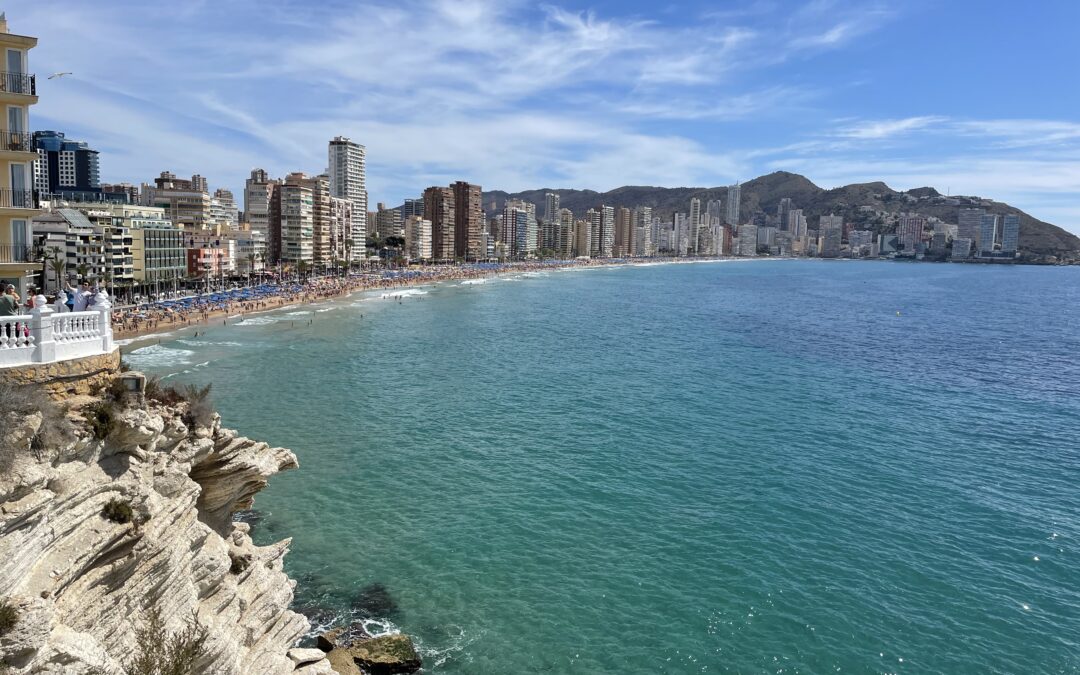
The ever changing skyline of Albir, Benidorm and Altea.
We’re currently staying near Altea, and from where we are, Benidorm’s high-rise skyline is clearly visible on the horizon. It actually reminds me a bit of the Gold Coast in Australia which we have seen plenty of times when our kids grew up. I have taken a few photos of that skyline, and it genuinely seems to change every time we look at it—light, weather, mood—it’s always a little different.
After three weeks of watching it from afar, we finally decided to take a closer look. It was Good Friday—always a bit of a wildcard when it comes to outings. But the drive in turned out to be less hectic than expected. Honestly, we expected a slow procession of cars heading for the center, but this time, it was smooth sailing.
A Few Quick Facts About Benidorm:
It has a population of just under 75 k.
In summer, that number skyrockets to over 400k—possibly to levels best described as “bursting at the seams.”
Facilities? Let’s just say, if you need it, Benidorm probably has it.
First impressions
As we approached the town, our first impression was that it looked like a typical Spanish city. You don’t immediately see the towering high-rises unless you catch a glimpse down one of the side streets. We managed to park in a covered garage quite close to the center—plenty of spaces and no stress.
From there, we strolled towards the beach, aiming to find the “old town” that several people had recommended. We wandered through a few lively streets, passed numerous shops and cafés, and eventually arrived at the beachfront. But somewhere along the way, we seemed to have missed what we thought would be a quaint, historic district.
Where is the old town?
It’s possible that we expected something similar to Altea’s old town, with cobbled lanes, flower-draped balconies, and a certain charm. What we found was more of a bustling commercial hub—restaurants, pubs, souvenir shops, and everything in between. It certainly caters to the crowds, which, judging by the numbers, it handles with ease.
Peace and quiet! Not on this beach…..
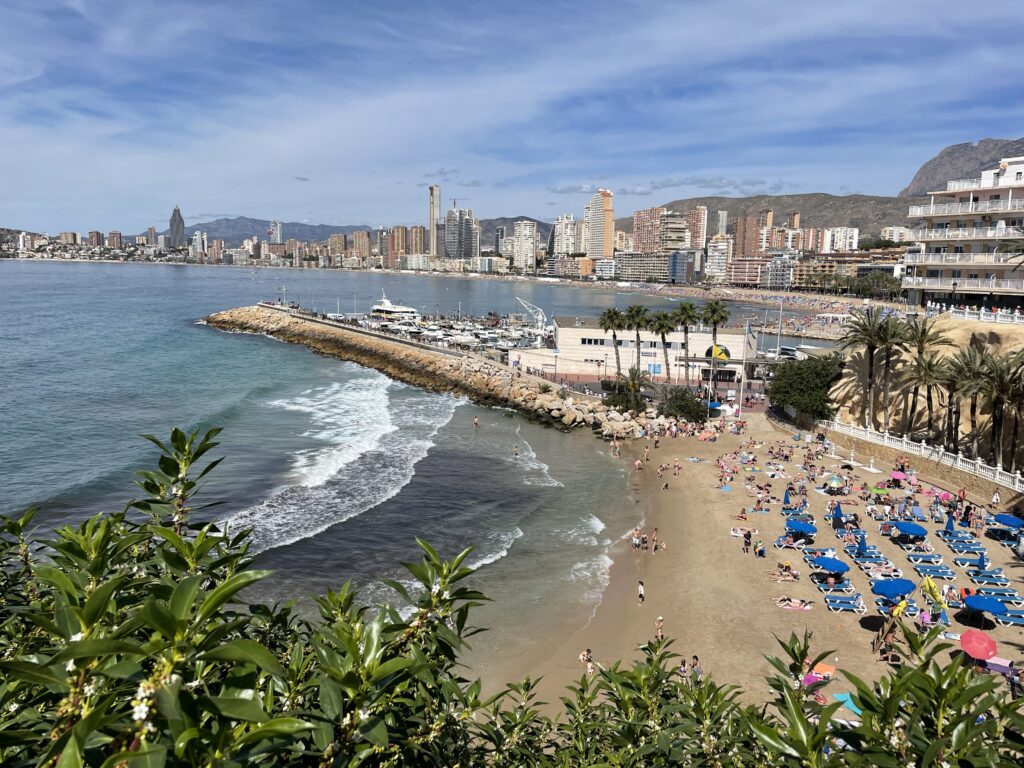
And speaking of crowds… the beach was absolutely packed. It honestly reminded me of Bondi Beach in Sydney on Christmas Day which we experienced before having kids. The weather was glorious, and clearly, everyone had the same idea.
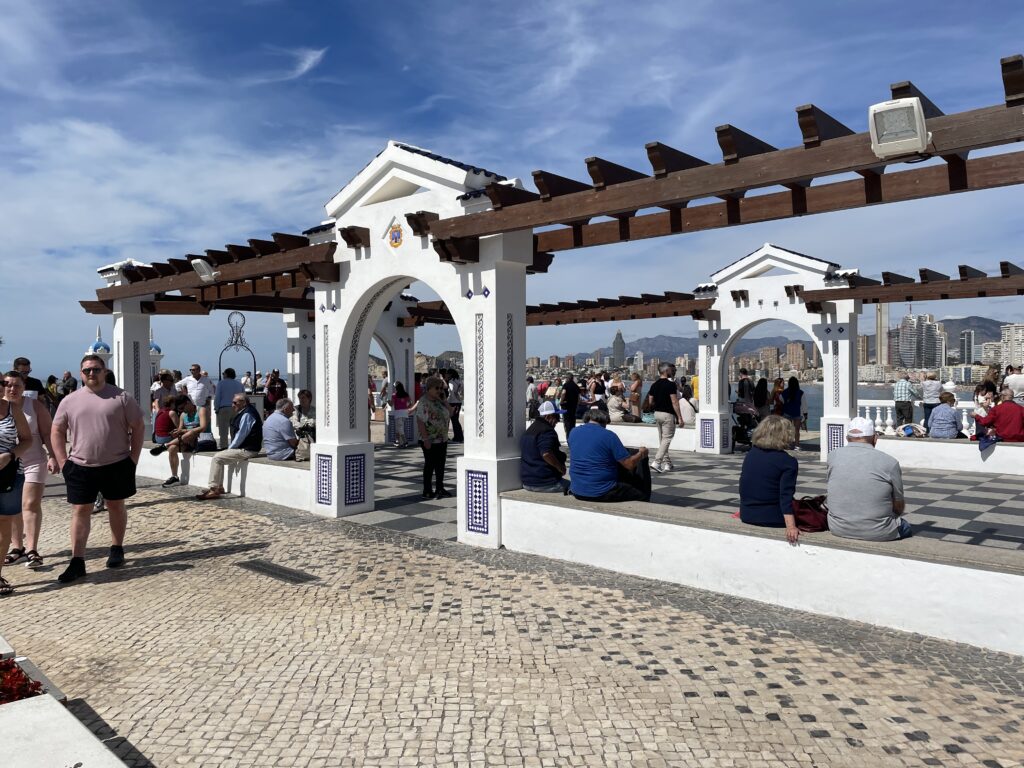
We continued exploring and discovered another bay just around the headland—again, wall-to-wall sunseekers. In between is a lovely lookout point, a mirador built on the site of what was once a castle. It offered stunning views of the coast either way and was clearly a popular photo stop.
El Mirador de Benidorm – one of the city’s landmarksLooking south towards Alicante
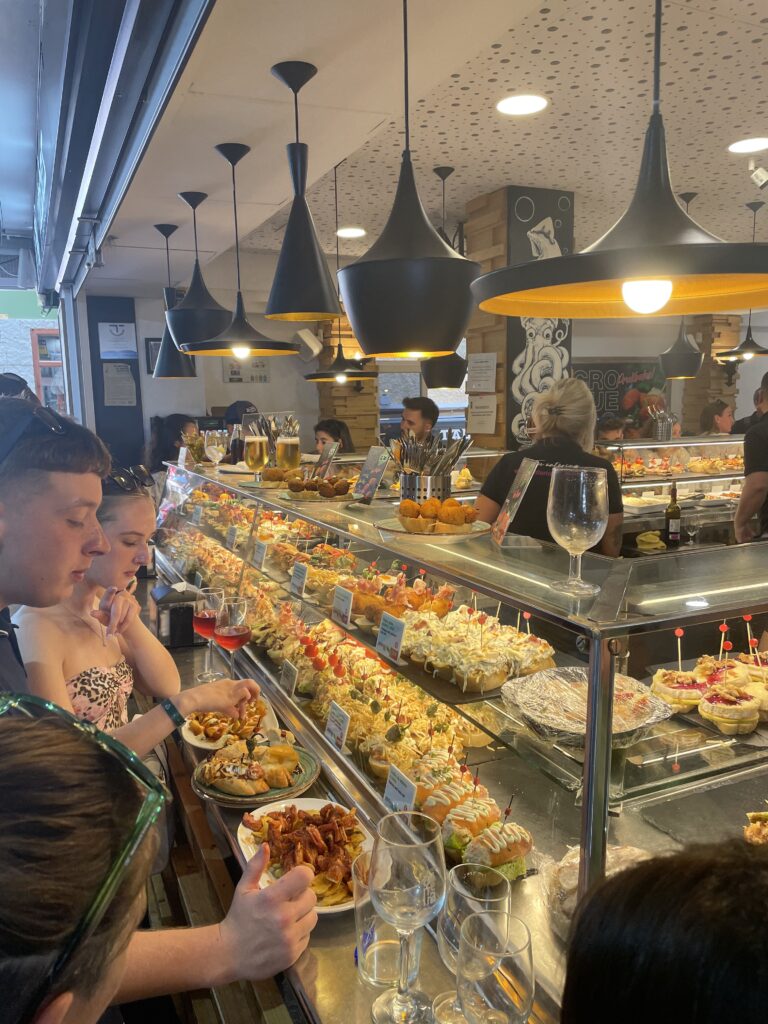
Benidorm’s shopping streets are extensive, with a mix of local and international brands. And like Alicante, it has ‘eat streets’—entire stretches where one restaurant follows another. While exploring those, we noticed something interesting: tapas and pintxo bars were mostly filled with locals and Spanish holidaymakers, while the establishments serving fry-ups, burgers, and pizzas had a distinctly North European clientele.
Benidorm – final thoughts!
We spent a few hours in Benidorm and came away slightly surprised—and a little amused—by our experience. Would I choose to holiday there? No, not really. But oddly enough, I wouldn’t mind spending some time there under the right circumstances.
This could entice me for another visit!!
Here’s why:
In the city center, you’re not really aware of the skyscrapers or the overcrowded beaches.
If you find the local spots, you’re surrounded by Spanish speakers and tasty spanish food, not sunburnt tourists on a mission.
And if you look past the obvious tourist zones, it starts to feel like a regular Spanish town—one where people live, work, and go about their day.
One thing to be clear about: we visited during Easter. I’m not sure I’d be quite as relaxed about the idea if it were peak summer.
Would I return in July or August to find out? Let’s just say—I’m quite happy not knowing.
🧐 Handy Tip: If you’re driving in, aim for the parking garages near the center—they’re easier and less stressful than circling endlessly in the heat.
I’m 60+, I work online (still on UK hours), and I’ve started flirting with the idea of moving to Spain. Not just more sun, coast or inland, but a different scene and the chance to get an Australian pension as that will never happen in La France! Spain, especially the Costa Blanca, kept showing up in that new vision.
While I am writing this, we have been in Spain three months and literally only scraped the surface with our research. One of the questions that keeps on hitting us is” Should we live by the coast or inland? They’re close on the map—but offer totally different vibes.
🌊 Life on the Coast: Breezes, Buzz, and Barefoot Days
There’s something instantly seductive about the coast. Just imagine early morning walks on the beach followed by a coffee with sea views. In other words a gentle buzz of life that feels just right.
In towns like Altea, Moraira, or Calpe, life flows around beach promenades, cafés, markets, and marina views. It’s easy to settle in, easy to meet people, and easy to romanticise. (Because it is romantic.)
What I like about coastal life is the walkability, the sense of community and constant ‘sea’ inspiration. If speaking Spanish is still a work in progress, English-speaking support is usually more available if you need it.
Coast or inland – what appeals more?
Being able to pop out for a beach walk on a work day, gives you that “mini-holiday” energy. Usually you’ll have quick access to restaurants, events, and social life
But here’s the catch! It will get crowded in high season and property prices and rents are higher. Many of the coastal towns feel more expat than España and supermarkets are stocked with marmite, Dutch bread rolls and German sausage.
🌄 Inland: Tranquility, Tradition, and Real Spanish Life
Then if you drive 30–40 km inland, the whole mood shifts! You find hidden villages surrounded by almond groves, terraced hills, and views that stretch for days. It’s quiet, slow, honest, Spanish and you may need some Spanish vocab.
Towns like Jalon, La Nucia and Finestrat offer a real chance to get a taster of a more authentic Spain.
What I love about it is the peace, space and the sky. You have to see the sky to believe it. There is more affordable housing with character and often more land! Sometimes a bit too much because really, what would you want with 10 hectares.
Inland you live more like the Spanish locals do, it has more seasonal living and locals still say ‘Buenes’ and mostly mean it.
But you need to be okay with having a car, in fact you’ll need one! There are fewer restaurants and fewer or no options for shopping. It could be hotter in the summer but you’ll have cooler nights and no humidity.
“Inland feels like returning to yourself. No fuss—just life, a little slower.”
So coast or inland… What’s right for me?
My gut feeling says maybe both. Considering my age, one thing stands out and that is proximity to medical help. We have learned that distance is not always the issue as a motorway allows you to do 40km in a whizz. On the other hand a town only 15 km inland could be impossible to navigate. Especially when the road is steep, windy and dangerous at night.
So we are still exploring and listening to our bodies and calendars but I’ll say this! If you want to stay connected with like minded souls and be more cushioned, the coast has your back. If you want simplify and go deeper, inland might just feel like coming home as long as it is accessible.
What about you – coast or inland?
If you’re thinking about a lifestyle reset—whether it’s a full move or just a season—maybe this is the nudge. I’ll keep sharing my journey, the wins and wobblies alike.
Next up? “Rent or Buy in Spain: What Makes Sense When You’re 60+ and Still Working?”
Follow along, ask questions and dream with me. Although this chapter is mine, it could be yours too.